

When distance stops being a problem
A memorable experience that makes professional interaction easier.
When distance stops being a problem
A memorable experience that makes professional interaction easier.
Bubble Gubble is a Massive Remote Business Simulation (MRBS) designed so that a large, dispersed group lives, at a distance, an emotional experience equivalent to being in the same room. Motivation, bonding and a sense of belonging no longer depend on sharing an office.
Distance pulls teams apart before anyone notices.
When a team is spread across countries, sites and time zones, collaboration closes in on the immediate group, conversations turn asynchronous and getting to know someone new becomes harder every month. What is lost is not today’s output: it is the bond that makes it possible to ask for help, to disagree and to trust.
This is what Bubble Gubble feels like
One shared world, dozens of countries opening cycle after cycle, and decisions that change everyone else’s market. Watch it in just over a minute.
Compete, cooperate and win without leaving your desk
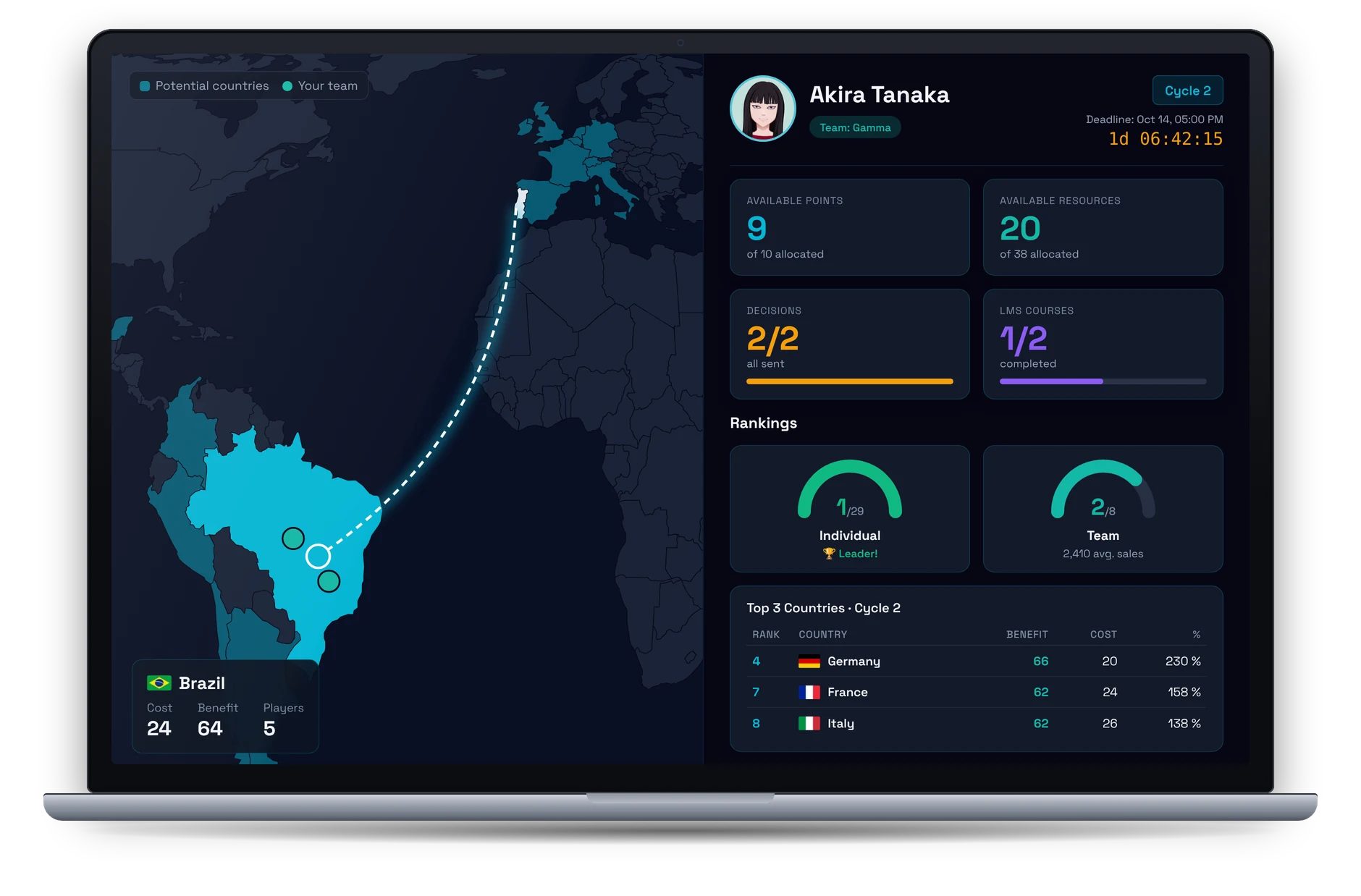
Every participant runs a company in a shared world. Each cycle they choose where to open and how much to invest, and the decision cannot be undone: everyone sees the result. As the game goes on, it rewards the group’s joint presence more and more over individual investment. Cooperating stops being advice and becomes the only way to grow.
Global
Teams from any country and time zone, with different cultures, communicating in more than 100 languages.
Relational
An anonymous start guarantees genuine interaction, free from the influence of hierarchy or prior acquaintance. People get to know each other through their interactions.
Experiential
Learning from decisions and mistakes in a risk-free environment, over several weeks, at each person’s own pace.
Built for large, dispersed groups with little time. Bubble Gubble is always played asynchronously, over 3 to 6 weeks depending on your objectives, with up to 96 participants per edition (although we recommend 64). Organised in teams, it takes no more than an hour to an hour and a half a week, with the option of a weekly live webinar. Training Games provides two facilitators: the game master, who runs the kick-off, the webinar and the wrap-up, and the game tutor, who supports each participant with their questions, their strategy and their decisions, and helps them solve problems.
Soft skills development
Proactivity and resilience, with a collaborative intent. Results depend on the combination of everyone’s decisions. Whoever waits for someone else to move loses ground; whoever adapts after a bad cycle recovers; and whoever reaches out to others before deciding wins. The game turns three attitudes into habits: taking the initiative, absorbing mistakes and counting on the group.
Analytical thinking and data-driven decision-making. There are only two decisions, and both are very simple: it is the context that makes them complex. Up to 48 countries with different characteristics and, above all, the other participants making decisions and adapting their strategy as the game unfolds.
From the bond between people to the team’s results
A good personal relationship is not an extra on top of the professional one: it is its condition. People with a best friend at work are far more engaged and stay longer, and only 2 in 10 have one (Gallup, 2022).
Safe to disagree
The factor that most distinguishes the highest-performing teams is being able to take risks in front of each other (Google, Project Aristotle). In the simulation people decide, fail and decide again without exposing themselves.
No travel, no classroom
The whole organisation, in every country, in the same game at the same time. No trips, no impossible shared diary.
Visible results
At the end, a game analysis gives each participant and the organisation not only their sales, but their learning, their relationships, their integration in the group, their ability to reach agreement and their adaptability.